Blog
Sprain or Strain: Understanding the Difference and the Symptoms
Posted by Évolution Physio — on Monday, May 12, 2025
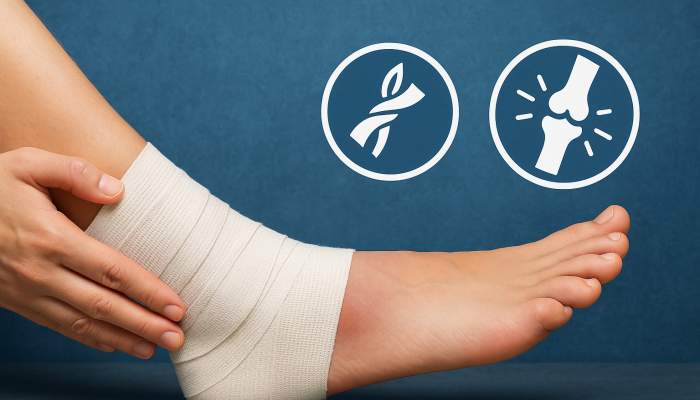
You recently injured yourself and are wondering whether you have a strain or a sprain? You’re not alone: many people use these terms without knowing the difference between a sprain and a strain. However, understanding your injury is essential to ensure proper recovery and avoid complications.
In this article, we explain everything you need to know about sprains, strains, their symptoms, and the best treatment strategies for effective healing.
What is the difference between a sprain and a strain?
Let’s begin by clarifying an important point: there is no real difference between a sprain and a strain in common language. Both terms are often used to describe the same type of injury—damage to the ligaments of a joint.
In simple terms, a sprain (sometimes referred to as a strain in everyday language) occurs when a joint is suddenly forced beyond its normal range of motion, causing a stretch or tear in the ligament fibers. “Sprain” is the more precise medical term, while “strain” is sometimes used more casually in everyday speech.
What is a sprain or strain?
A sprain (or strain in common language) is an injury to the ligaments, the strong bands of tissue that connect bones together at the joints.
Depending on the severity of the trauma, ligament injuries are classified into three grades:
- Grade 1: Mild stretching of the ligament fibers.
- Grade 2: Partial tear of the ligament.
- Grade 3: Complete tear, often associated with joint instability.
Recovery time for a sprain typically ranges from 4 to 8 weeks, depending on the severity of the injury. Prompt and appropriate treatment is essential to prevent long-term complications or chronic joint weakness.
Where do sprains occur?
The ankle is the joint most frequently affected by sprains. An ankle sprain can occur during:
- A sudden change of direction during sports
- A misstep on uneven ground
- A simple fall, such as stepping off a curb awkwardly
Other joints can also be affected, including the knee, wrist, and thumb.
Symptoms of a sprain or strain
Whether you call it a sprain or a strain, the symptoms are generally similar:
- Immediate or gradually increasing pain
- Rapid swelling around the injured joint
- Reduced range of motion
- Weakness or instability when using the affected area
After an injury, it is recommended to consult a healthcare professional, especially if:
- All movements become painful
- Even a simple muscle contraction triggers pain
- Tapping or pressing on the nearby bone is very painful
In some cases, X-rays may be required to rule out a possible fracture.
What to do in case of a sprain or strain?
At the first signs of injury, apply the P.O.L.I.C.E. protocol:
- Protection: Partially immobilize the joint.
- Optimal Loading: Move gently within pain limits to avoid complete immobilization.
- Ice: Apply ice to reduce inflammation.
- Compression: Use a compression bandage to limit swelling.
- Elevation: Elevate the injured area to promote fluid drainage.
A prompt evaluation by a physiotherapist is strongly recommended to guide rehabilitation and prevent long-term complications.
How to effectively treat a sprain or strain
At Évolution Physio, our experienced physiotherapists provide a personalized treatment plan starting with the initial assessment. Treatment aims to:
- Reduce inflammation and relieve pain
- Gradually restore mobility and muscle strength
- Strengthen the joint to prevent recurrence
- Ensure a safe return to daily and sports activities
Specific exercises including gentle mobility work, stretching, and strengthening will be adapted to your condition and your progress. A gradual return to physical activity is recommended to minimize the risk of reinjury.
Conclusion: sprain or strain—act quickly!
Whether you call it a sprain or a strain, the priority is to seek professional care quickly to obtain an accurate diagnosis and appropriate treatment.
The sooner you act, the better your chances of fully regaining mobility and reducing recovery time.
Suffering from a sprain or strain? Come see us!
Don’t let a sprain slow you down. At Évolution Physio, we specialize in the treatment of musculoskeletal injuries. Our professionals will guide you through every stage of your recovery with care tailored to your needs.

Articles on the same topic that may interest you